


Syllabus: GS3/S&T/Environment
Context
- Lab-grown diamonds are emerging as a sustainable alternative to the mined stones.
About
- Some of the world’s largest diamond mines, such as the Argyle mine in Australia and the Diavik mine in Canada, have reached a point of exhaustion in recent years.
- This depletion has worsened year by year, and production is now at a multi-decade low.
- It is estimated that the 40 diamond mines accounting for 90% of global production spread throughout Botswana, Russia and other countries have a lifespan of no more than 50 years.
Concerns Associated with Diamond Mining
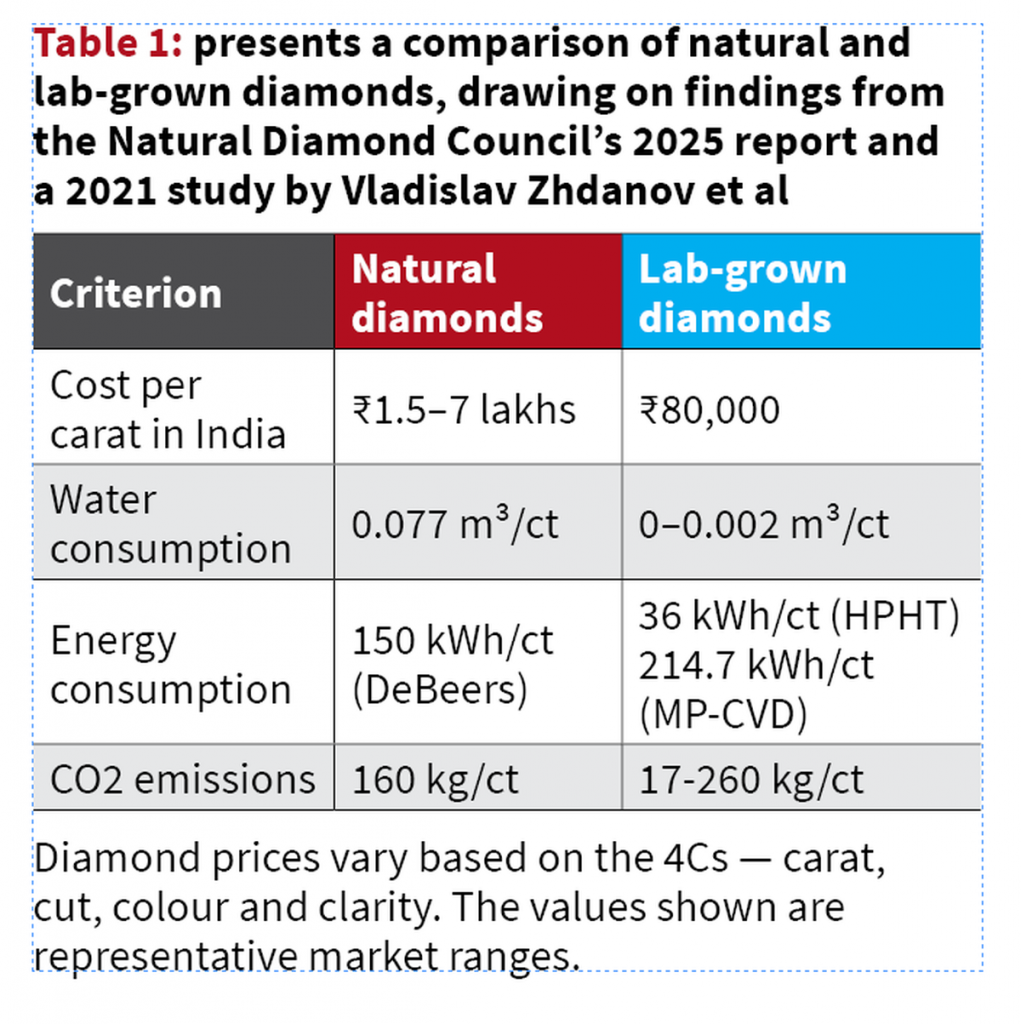
- Environmental Concerns: Diamond mining requires large amounts of water and energy and causes considerable damage to the surrounding ecosystems.
- It is often associated with deforestation, displacement, soil erosion and water pollution.
- Massive open-pit excavations can also trigger landslides and mudslides.
- Health Hazards: Labourers suffer from a plethora of diseases as a result of working in diamond mines.
- A study in 2011 found that workers are at risk of asbestos exposure and may develop asbestos-related diseases, including asbestosis, pleural plaques, and mesothelioma.
- Blood Diamonds: These are mined diamonds involved in illicit sales and used to fund military action. It is nearly impossible to deduce a diamond’s geographic origin.
- Although the Kimberley Process was introduced to verify that diamonds are conflict-free, regulatory gaps continue to allow blood diamonds to be smuggled across borders.
- Carbon Footprint: Diamonds created using coal-heavy power grids have higher carbon emissions, while those manufactured using renewable energy sources have a much lower carbon footprint.
Lab-Grown Diamond as an Alternative
- The first proven synthetic diamonds were made by GE (General Electric) in 1954, under a project codenamed “Project Superpressure.”
- They utilised the HPHT (High Pressure, High Temperature) process, which mimics the conditions under which natural diamonds form in the Earth’s mantle.
- Lab-grown diamonds are chemically, physically and optically identical to their natural counterparts.
- Composition: Pure carbon
- Crystal structure: Same as natural diamonds (cubic crystal lattice)
- They are made using technologies like the chemical vapour deposition (CVD) and high-pressure high temperature (HPHT).
- HPHT (High Pressure High Temperature)
- Mimics the Earth’s mantle conditions.
- Carbon is subjected to extremely high pressure and temperature to form diamonds.
- CVD (Chemical Vapour Deposition)
- Carbon-rich gas (like methane) is broken down in a vacuum chamber.
- Carbon atoms deposit layer by layer on a diamond seed crystal.
- How are they different from Natural? The natural diamonds contain small traces of nitrogen, whereas the lab-grown diamonds are nitrogen-free.
- Lab-grown diamonds are eco-friendly and conflict-free. Unlike mined diamonds, which displace up to 250 tonnes of earth and emit greenhouse gases, lab-grown diamonds use less water and energy.
- Market of Lab Grown Diamonds: As of 2024 around 90% of the world’s diamonds are processed in India, accounting for approximately 75% of global turnover by value.
- The lab-grown diamond market is expected to make up 16% of the global diamond market by 2029 from 12% in 2024.
Conclusion
- The lab-grown diamonds align with the United Nations Sustainable Development Goals (SDGs), which emphasise the transition to cleaner energy systems and more sustainable manufacturing practices.
- Furthermore, the use of renewable energy in diamond production reflects the principles of a circular economy, where resources are utilised more efficiently and environmental impacts are minimised throughout a product’s life cycle.
Source: TH
Previous article
Agrivoltaics: Powering AI Infrastructure Sustainably
